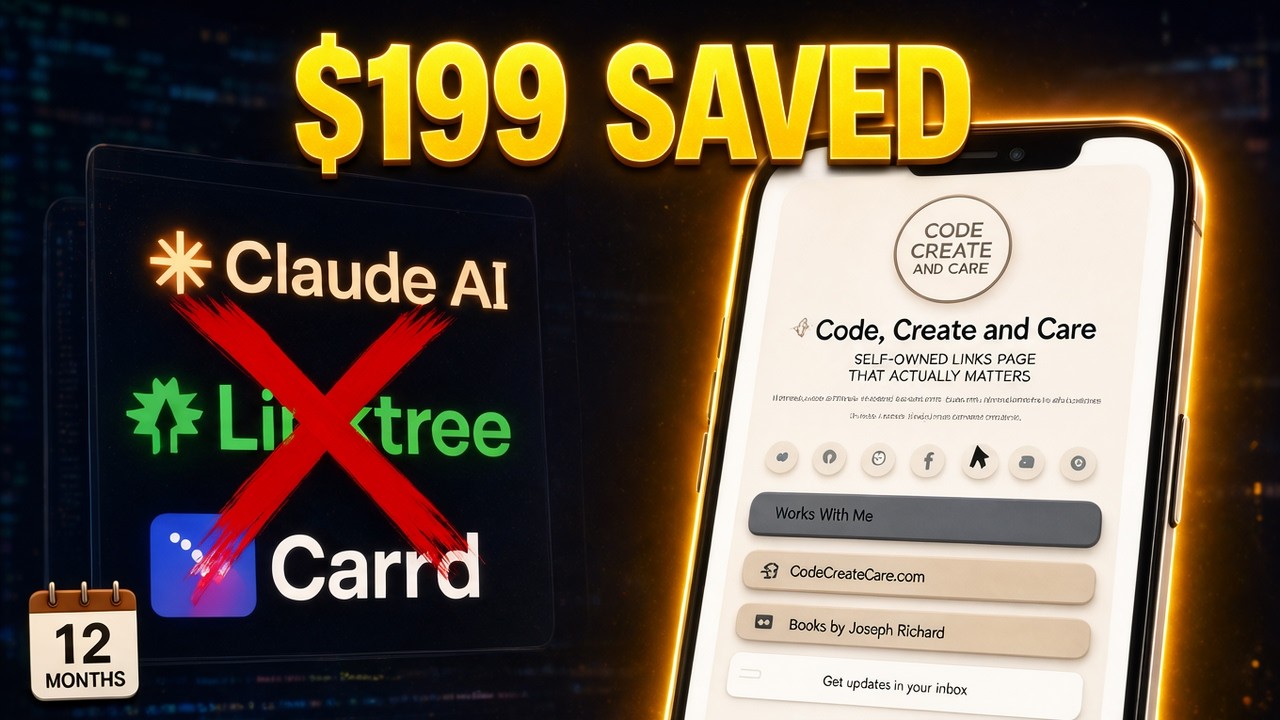
I built my website with Claude & Antigravity—Then Made It Mine

I built this website with Claude working as an agent inside Antigravity, starting from one YouTube banner and one prompt. It worked fast, but it didn't feel like my website. I recreate the original build, then show the three human decisions that turned the generated first version into my site.
Key takeaways
- Use an image, like your YouTube banner, as the brand reference instead of describing it in words.
- Ask for the setup files up front: index.html, a css folder, sitemap.xml and robots.txt.
- Decision 1: simplify by removing buttons, extra navigation and whole sections.
- Decision 2: make it feel like the brand, down to one heading's font, weight, size and color.
- Decision 3: use the space you already have.
Chapters
- 0:00 It worked… but it wasn't mine
- 0:27 Back to Version One
- 0:56 Give it something to work with (one banner, one prompt)
- 1:27 Claude + Antigravity
- 1:53 Would you launch this version?
- 2:30 Decision #1: Simplify
- 3:08 Decision #2: Make it feel like the brand
- 3:51 Decision #3: Use the space
- 4:50 What did 20 years of experience add?
- 5:54 Would I do it again?
Tools used
Claude, Antigravity
Transcript
Read the full transcript(about 1100 words)
0:01I built this website using Claude and Antigravity, and honestly, it worked. I had a functioning website remarkably fast, but there was one problem. It didn't feel like my website. So the interesting part of this project wasn't getting AI to build a web page.
0:18It was everything that happened after it did. I'm going to show you the three human decisions that made it mine, and whether I'd do it again. Now, the website you're looking at today isn't the original version. I've already updated it a couple of times.
0:34I've added the email capture system from another project, and later I updated the site again with my YouTube content. But when I originally built Version One, I made one mistake. I didn't record it. So I'm recreating that original build using essentially the same process I used the first time.
0:51And the whole thing started with one image. This is my YouTube banner. I already had the colors, typography and basic visual identity I wanted for Code, Create & Care. So instead of trying to explain the brand entirely with words, I gave the AI something visual to work from. I also gave it the basic structure I wanted for the project. Claude handled all of those setup files I used to create by hand. And pretty quickly, I had something I could actually look at.
1:23Now I needed to decide what I thought of it. For this build, I'm working inside Antigravity, with Claude selected as the model behind its AI agent. The agent can work directly with the project, but I can also open the files and make changes myself. And I can run the website locally while I'm working. That means when something changes, I can see the result almost immediately. And that makes experimenting incredibly fast. So here's what it gave me first. This is the first real version.
1:56The branding is recognizable. The sections are there. The page works. And I got here remarkably quickly. So before I show you what I changed, take a good look at it. Be honest, would you launch this version? Yes or no in the comments? Would you put it online and improve it later? Or would you keep working? I kept working. The site functioned. I just didn't like some of the decisions yet. And I started with something I normally have a hard time doing. I took things away. The first version simply had too much going on. There was a Subscribe on YouTube button, another button to watch the next video and navigation options I didn't really need.
2:42None of these things were helping me get to the simpler site I wanted, so my first decision was to take things away. I had the agent remove the buttons, I simplified the navigation, and instead I made it easier to find the places where I'm actually publishing content.
2:59YouTube, X, Instagram, Facebook. And just by removing things, the site already felt closer to what I had pictured. Then I got to this heading, A More Thoughtful Tech Life, and I kept looking at it thinking, no, that's not it. The font didn't feel right, so I changed it. Then the weight, then the size. I wanted the entire phrase on one line, and finally, I changed the color so it fit the rest of the brand better. This is where the process stopped being about whether the website worked. It was about whether it felt like Code, Create & Care. There isn't a test that can tell me which font feels right, or exactly how large that sentence should be. That's a judgment call. The AI made each change fast, but I had to decide whether it finally felt right. Then I looked at the Code, Create & Care graphics. They felt crowded together, but the page had all this unused space. So this wasn't really a question of adding something. It was, why aren't I using the space I already have?
4:05I had the agent spread the graphics further across the page. It's a small change, but put it next to the typography changes and the things I removed and the site starts to feel very different. And those were the three decisions. Simplify it, make it feel like the brand, use the space better. That's when I realized the AI wasn't removing me from the development process. It was changing where I spent my time. Instead of manually implementing every little change, I was spending more of that time deciding, do I need this?
4:38Does this look right? Does this fit the brand? What should change next? Those little decisions are how a generated first version became my website. But there's another part of this I keep thinking about. I've been developing software for more than 20 years. Before the agent generated anything, I already had an idea of how I wanted the project organized. I knew I wanted the styling separated. I knew I wanted a sitemap to help search engines discover the pages on my site and a robots file to guide their crawlers. Those aren't things the AI suggested. They're things I brought into the process. So what happens when somebody without that experience tries the exact same thing? Does AI remove the technical barrier? Or does it move the barrier from knowing how to write the code to knowing what to ask for? I don't think we completely know yet. And I didn't try to solve every future problem with Version One. Later, I needed email capture, so I added it. Then I wanted the site to feature my content, so I added that. That's becoming an important rule for how I'm building the business. Build what I need, use it, then improve it when I have another real problem to solve. So, would I build another website this way?
5:58Absolutely. Using Claude with Antigravity got me from an idea to a functioning first version incredibly quickly. Being able to run the site locally and see the changes immediately made experimenting fast. But getting the website to work wasn't the finish line.
6:13It was the starting point. The tools helped me build it. Then I made it mine. So now that you've seen the final version, did I make the right calls? If you said yes or no earlier, tell me if you changed your mind. That's what I'm doing here with Code, Create & Care. I'm using these tools on things I'm actually building and showing you what really happens. When it's good, when it's not quite right, and when it breaks, I'll show you. If you're building something of your own, subscribe and follow along.
From the video's captions, lightly cleaned up. Click a time to watch from that moment.